Taitung Travel Guide
Things to Do in Taitung: A Local's Map of the Coast, Valley & Mountains
We live here and run our own cars, tours and stay — so this is the map we'd actually hand a friend: the signature sights of Taitung sorted by region, what each one feels like, and what's closed or guide-only right now.
Sam Hu·Updated 2026-06-26 · 11 min read
We live in Taitung, and we run our own chartered cars, small-group tours and a place to stay here. So this isn't a neutral list scraped from a hundred other sites — it's the map we'd actually draw on a napkin for a friend who just landed and asked, "Okay, where do I go?"
Taitung is long. It runs nearly 180 km down the southeast corner of Taiwan, pressed between the Pacific on one side and two mountain ranges on the other. Trying to "see it all" in two days is how people end up spending the trip in the car. The trick is to think in regions, give each one roughly a day, and pick a few sights you'll actually remember instead of fifteen you'll forget.
So that's how this guide is built — by region, from the coast inland to the mountains. For each place there's one honest line on why it's worth your morning, and a link to the deeper story if you want to go further. A few spots have closures or permit rules in 2026; we flag those plainly so you don't drive to a gate that won't open.
An honest note before we start: we're a local operator, not a review site pretending to be tourists. There are links to our own tours, chartered car and stay at the end. But everything here is written the way we'd tell a friend — no paid placements, nothing we haven't done ourselves, and where we're not sure of a price or an opening time, we say "check the latest official announcement" instead of making it up.
First, the honest caveats
A handful of Taitung's most-Googled spots have changed for 2026. Read these once and you'll save yourself a wasted drive.
- Sanxiantai's eight-arch bridge is closed for renovation (salt corrosion plus earthquake damage), from mid-2026 until the end of 2027. You cannot walk across to the islets right now. You view it from the mainland shore — and it's still very much worth doing (more below).
- Jialulan Recreation Area is closed for renovation until 2026/12/31. The driftwood art and that famous sea-frame are off-limits this year, so don't route your day around it.
- Lisong Hot Spring, Jiaming Lake and the Alangyi Trail are not casual stops. Lisong needs river-tracing and a licensed guide and carries flash-flood risk; Jiaming Lake is a multi-day high-mountain hike needing mountain-entry and park-entry permits; Alangyi needs a permit and a licensed guide. We'll point you to each, but please treat them as planned expeditions, not "let's swing by."
- The sky owes you nothing. Sunrises, stars and balloon launches are never guaranteed — Taitung's typhoon season (Jul–Sep) brings frequent afternoon thunderstorms, and launches are cancelled in poor weather, per Taiwan's Central Weather Administration. Go anyway. Even when the headline moment doesn't happen, a slow morning by this coast is not a wasted morning.
Taitung City: your warm, walkable base
Most trips start and end in Taitung City. It's small, flat and easy, and it makes a good base because almost everything else is a drive away.
You don't need a long list here. In the late afternoon, walk Taitung Seaside Park and the Railway Art Village — a decommissioned station turned into open lawns, old tracks and slow cafés, where the light goes gold over the Coastal Range and locals come out to walk the dog. It's the kind of place to ease off the train-and-traffic adrenaline and remember you're on holiday.
The city is also where you sort logistics: pick up your rental car, meet your driver, stock up on fruit and rice balls for the early mornings. Because once you head out, public transport thins fast.
The East Coast: the Pacific the whole way
Drive north out of the city on Highway 11 and the Pacific opens up on your right and basically doesn't leave. This is the stretch people picture when they imagine Taitung.
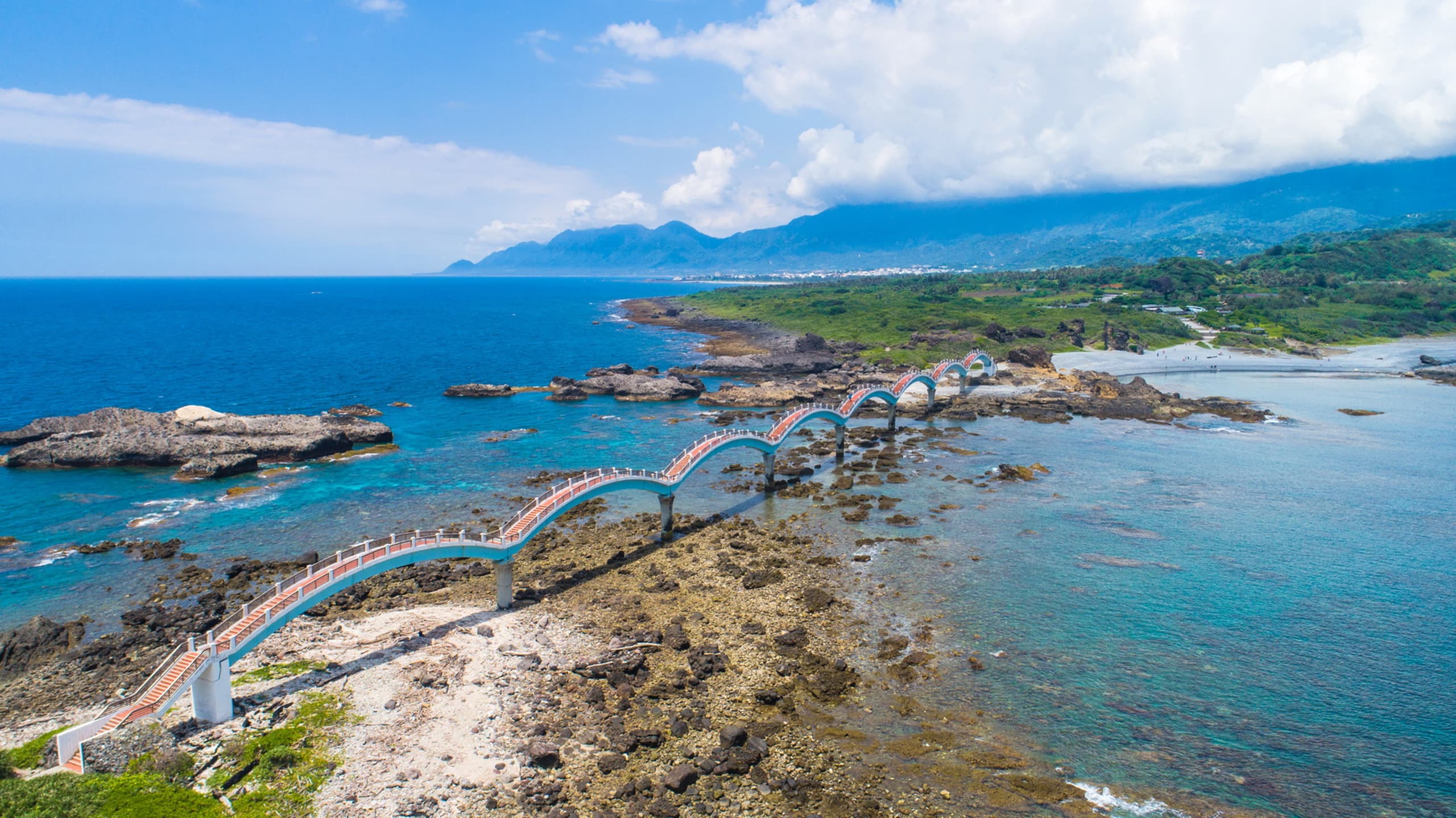
Sanxiantai (三仙台). The signature view of the east coast — three rocky islets, a white lighthouse, and a wave-cut platform that emerges at low tide. The red eight-arch footbridge that curves out to the islets is closed for renovation until the end of 2027, so you're viewing it from the mainland shore this year, not walking across. From the shore you still get the whole scene: the bridge arcing over the water, the islets behind it, the surf working the rocks. The visitor center and coastal paths stay open. Read our slow take on it: Sanxiantai, the eight arches by the sea.
A safety word for this whole coast: the Pacific here is powerful. Keep well clear of the tetrapods (those concrete sea-breakers), watch for sneaker waves that come further up the rocks than you expect, and stay out of the water entirely in rain, thunder or after a typhoon. With kids, one adult watches one child, full stop.
Jialulan (加路蘭) — closed in 2026. You'll see it praised everywhere as a driftwood-art seafront, but it's closed for renovation until 2026/12/31. Mentioning it only so you don't go looking for it this year.
The South Link: where the trains stopped but the sea stayed
Now turn the other way. Head south down Highway 9 and the South-Link Line, and the coast gets wilder and quieter.
Duoliang Station (多良車站). An elevated railway platform built into the hillside, facing the Pacific head-on. The trains don't stop here anymore, which is exactly why it's so peaceful: you stand on the old platform and there's nothing between you and the water but air. It's free, it's quick, and it's the kind of view that makes people go quiet. Here's the full story: Duoliang Station, by the sea.
Taimali (太麻里) — first light. Taimali is the place people come to watch the sun lift straight out of the Pacific. At first light the sky goes from charcoal to peach and the whole horizon catches fire — when the weather plays along. It often doesn't, and that's fine; even a cloudy dawn here, with the surf and the empty beach, is worth the early alarm. Our piece on it: Taimali, first light.
Deeper south, the Alangyi Trail (阿朗壹古道) is the last wild, road-free stretch of Taiwan's coastline — and it needs a permit and a licensed guide. It's a real walk on rolling pebble beaches, not a roadside stop, so plan it properly if it calls to you.
The Rift Valley: rice, balloons and red oolong
Swing inland and the landscape changes completely. The East Rift Valley runs between the two mountain ranges — a green corridor of rice paddies, tea estates and small towns. This is the gentle, golden-hour heart of Taitung.
Chishang & Boran Avenue (池上 · 伯朗大道). A ribbon of road running dead-straight through an ocean of rice, with no power poles to interrupt the view — just paddy, sky and the mountains beyond. You walk or cycle it slowly, and in the right season the wind moves across the green like water. It's free, and it's the lane everyone photographs in eastern Taiwan. See Boran Avenue, on foot and Chishang, where the rice moves like waves.
Luye Highland (鹿野高台) — the balloons. From July 4 to August 20, 2026, the Taiwan International Balloon Festival fills the sky over Luye with color (the site is closed on Tuesdays). The launches and the evening Night Glow concerts are free to watch; tethered rides run roughly NT$550 weekday / NT$650 weekend (online presale from May 27). The big news this year is the first-ever Chiikawa (吉伊卡哇) collaboration balloons — note they're ground display only, no rides. The "free flights" you'll see advertised are run by a private Luye operator (not an official festival item) and start around NT$9,000+ per person. Launches depend entirely on weather and are cancelled in poor conditions, per official announcements — go early, and don't bank on any single morning. Even if the balloons don't lift, the highland at dawn is its own reward. We keep a full breakdown here: the 2026 Taitung balloon festival guide.
Luye Deer Park (鹿野高台 · 草原). Even outside festival season, the grassy slope at Luye is a lovely, low-key afternoon — kids roll down the hill, paragliders drift overhead, and there's grass-sledding on site. It's one of the easiest places in Taitung to just let everyone slow down. Read an afternoon at the deer park.
Luye red oolong (鹿野紅烏龍). At the foot of the highland, the tea estates pour Luye's signature red oolong — a darker, honeyed brew unique to this area. A pot on a wooden veranda, the valley going gold, your driver waiting in the shade: this is the part of the day nobody plans and everybody remembers. Here's why we love it: a red oolong afternoon.
Mountains & tribes: go slow, and go with someone who knows it
Behind the valley, the land climbs fast into Indigenous country and serious mountains. Some of Taitung's most extraordinary places are up here — and most need either a guide, a permit, or both.
Sazasa (Luanshan / 鸞山) — the walking trees. An Indigenous Bunun forest where the strangler-fig roots crawl over boulders like something alive, so the trees seem to walk across the slope. You enter on a guided tribal experience (it's not a public park you wander into), and it stays in your head for a long time. Read Sazasa, the walking trees.
Lisong Hot Spring (栗松溫泉). A wild hot spring in a river gorge, with green and orange mineral terraces running down the rock where the hot water meets the river. But reaching it means river-tracing with a licensed guide, and it carries real flash-flood risk. This is a planned, guided trip, never a spontaneous one. The story, with the cautions: Lisong, the jade spring.
Jiaming Lake (嘉明湖). The "tear the angel dropped" — a high alpine lake reached by a multi-day high-mountain hike that needs mountain-entry and park-entry permits. Worth it, and absolutely not a day trip. If it's a someday dream, start here: Jiaming Lake, the angel's tear.
Zhiben: the soak at the end of the day
A short drive south of the city, Zhiben Hot Spring (知本溫泉) is where you go to undo the day. Tucked into a forested valley, it's been a hot-spring town for over a century — clear, mineral water, the river running below, the smell of the woods coming through the steam. After a couple of dawn starts and long coastal drives, an evening soak here is the kindest thing you can do for your legs. More on it: Zhiben Hot Spring.
How to actually string these together
Here's the honest planning truth: within Taitung, public transport is sparse and infrequent. The sights are spread across nearly 180 km, and the best moments — sunrise at Taimali, the 5:30am balloon launch at Luye — happen before any bus runs. So most visitors either rent a car or book a chartered car with a local driver.
The chartered-car option is the one we'd choose for the pre-dawn runs: you're not driving unfamiliar mountain roads in the dark, and someone who knows the weather and the back lanes is deciding when to leave. Here's how it works and what it costs: the Taitung chartered car guide.
Getting to Taitung from Taipei: take the TRA express train (Puyuma 普悠瑪 / Tze-Chiang 自強, roughly 3.5–4.5 hours — book early, they sell out on weekends and holidays), or a short domestic flight from Taipei Songshan (TSA → Taitung TTT, about an hour). Check the latest schedules and fares before you lock in.
And the simplest way to combine all of the above into a real trip: our 3-day, 2-night Taitung itinerary lays out a sane, region-by-region version — coast one day, valley the next, town and a soak to round it off.
Where we'd put you for the night
We partner with the Luminous Hot Spring Resort (鹿鳴溫泉酒店) — 11.3 hectares set against the Rift Valley, with its own hot springs, which means you're already close to Luye and the valley for those early balloon and rice-field mornings. It's the easy base for everything in this guide's middle section, and a soft landing after a day on the coast.
That's the map. Coast, valley, town, mountains — pick a couple of regions, go slow, and let the weather be the weather. Taitung rewards the traveler who isn't trying to win at it. Plan a region a day, keep one morning loose, and let the sea, the rice and the steam do the rest.
Next —
Turn this guide into a real trip?
Leave the car, the stay, the meals and the local guide to people who live in Taitung.
Tell us on LINE the version you want and we'll lay it out for you.
A rough plan & quote the same day · no charge unless you're happy · no hard sell
See our journeys first →