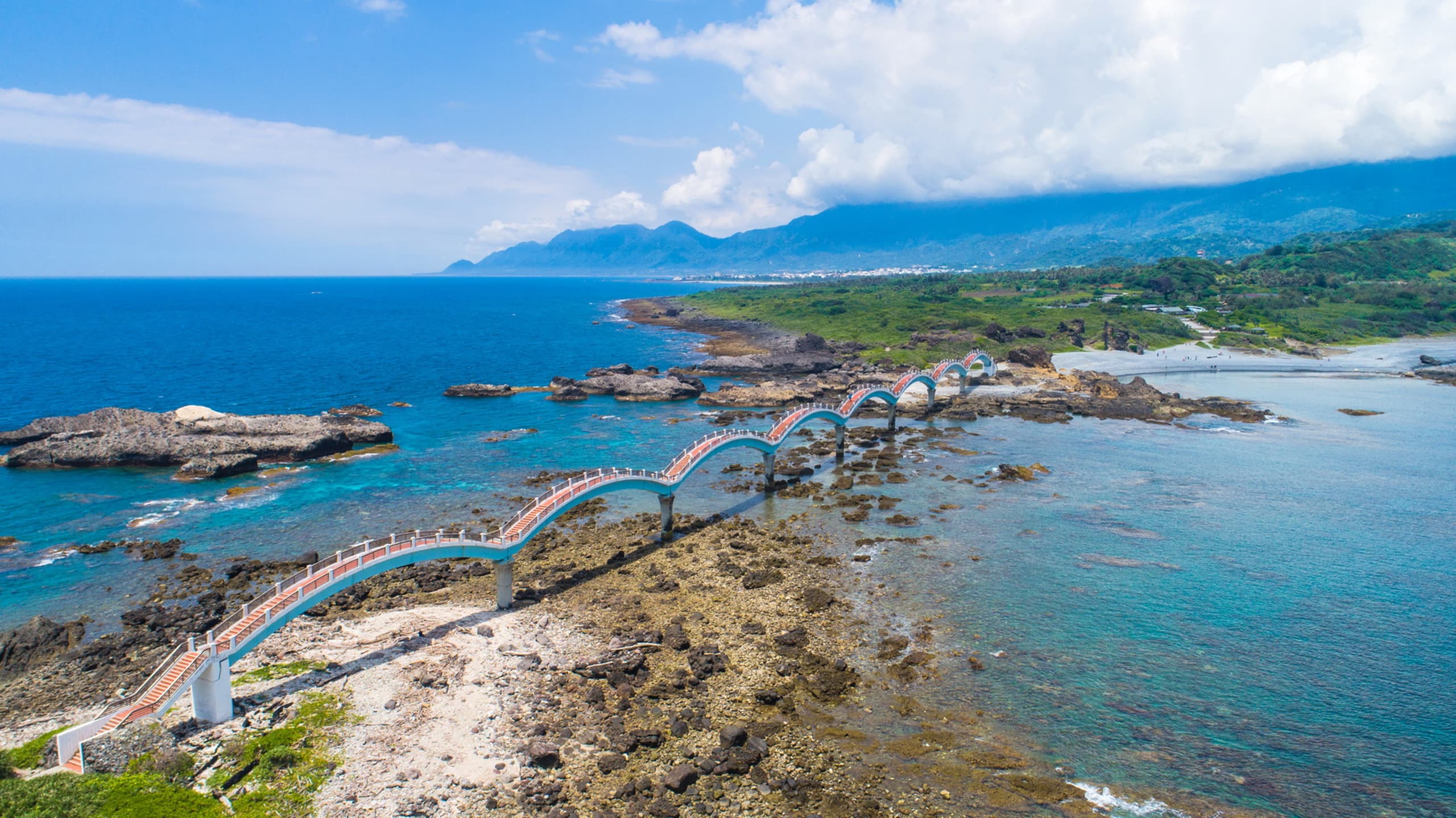
Sanxiantai · The Bridge Over the Sea · A Myth Made of Stone
The Bridge Is Closed. Is Sanxiantai Still Worth It?
In Puyuma legend, the immortals Lü Dongbin, Li Tieguai, and He Xiangu left their footprints here. Three rock islets, eight arching spans, and a tide that never stops — Sanxiantai is a letter the Pacific wrote to Taitung.
海岸編輯室·Updated 2026-05-31 · 5 min read
Drive north on Provincial Highway 11 (台 11 線), past the town of Chenggong (成功), and the coastline gives a sudden bend.
Where it curves inward, you've reached Sanxiantai (三仙台).
Three Rock Islets, Eight Arches, One Legend
Sanxiantai is a cluster of three rock islets, less than 200 metres offshore — built of coral reef and volcanic stone. The tallest, Footprint Rock (仙跡岩), rises about 70 metres.
The elders of the Puyuma (卑南族) tell it this way: long ago, three immortals — Lü Dongbin (呂洞賓), Li Tieguai (李鐵拐), and He Xiangu (何仙姑) — wandered east from the western lands and rested on these three islands, leaving behind their footprints and the marks of their alchemy. Ever since, the place has been called Sanxiantai, the Terrace of the Three Immortals.
What ties the mainland to the three islands is Taiwan's most iconic bridge over the sea — eight arches that rise and fall like eight Ws, some 320 metres end to end. The crossing takes fifteen minutes, and every crest offers a new vantage: to the right, the open Pacific; to the left, the mountains of Taiwan's main island; below, water clear enough to show the coral.
Closure notice: The eight-arch bridge is closed for renovation after damage from salt corrosion and earthquakes. From 4 May 2026 the bridge is shut and no crossing is allowed, with works expected to finish by the end of 2027. During the closure you cannot walk out onto the bridge or reach the loop trail on the islets. Still open: the mainland-side coast, the white lighthouse, the wave-cut platform at low tide, and the visitor centre — and from the shore you can still take in the eight arches and the three offshore rock islets. Please confirm current access with the official notices of the East Coast National Scenic Area (Tourism Administration, MOTC) before you go.
Sunrise Is Sanxiantai's Most Precious Hour
Sanxiantai is among the first places on Taiwan's main island to catch the sun.
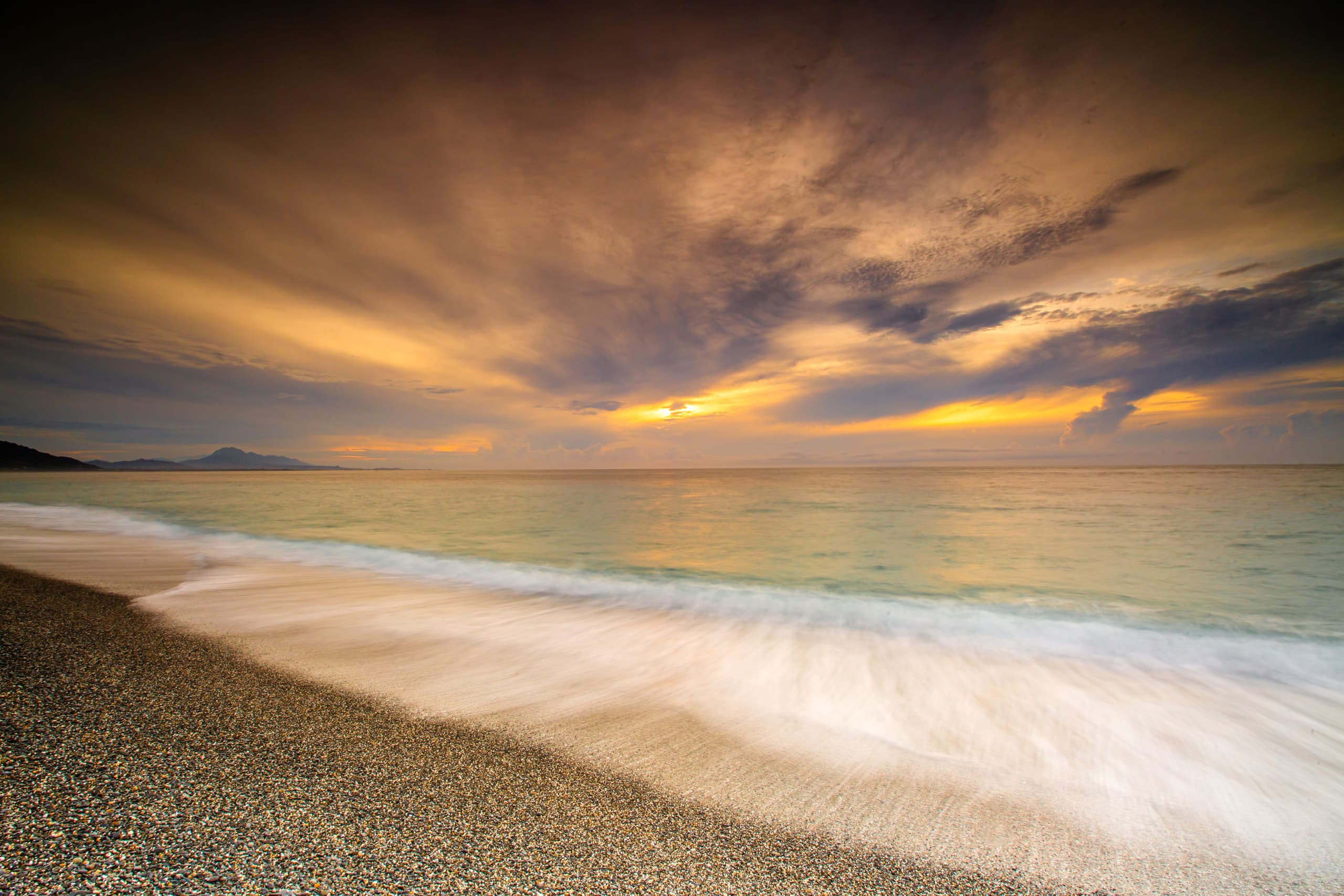
Around 05:00 in summer, about 06:30 in winter, the sun leaps clear of the Pacific horizon — gilding first the silhouettes of the three islets, then lighting the eight arches one by one, until the whole scene looks like a photograph slowly surfacing in the developing tray.
A local tip: arrive 30 minutes early (04:30 in summer, 06:00 in winter). Watch the sky shift from the car park first, then move down to the mainland-side shore around the white lighthouse — the best spot for photographs while the bridge is closed (when it reopens, the crest of the first arch is the classic vantage).
More Than the Bridge
Sanxiantai isn't a place you photograph and leave.
- The coastal trail: once the bridge reopens to foot traffic, a loop trail across on the islets circles them in 40–50 minutes, revealing all three rocks from changing angles, along with sea-carved formations and coastal vegetation. During the closure, follow the mainland-side coast instead, taking in the rocks and arches from the shore
- The wave-cut platform: at low tide, a broad shelf of eroded rock emerges before Sanxiantai, letting you walk almost to the water's edge (mind the tide table — a rising tide can strand you)
- The white lighthouse: a small lighthouse on the mainland side, a favourite among photographers — it frames beautifully with the arches of Sanxiantai
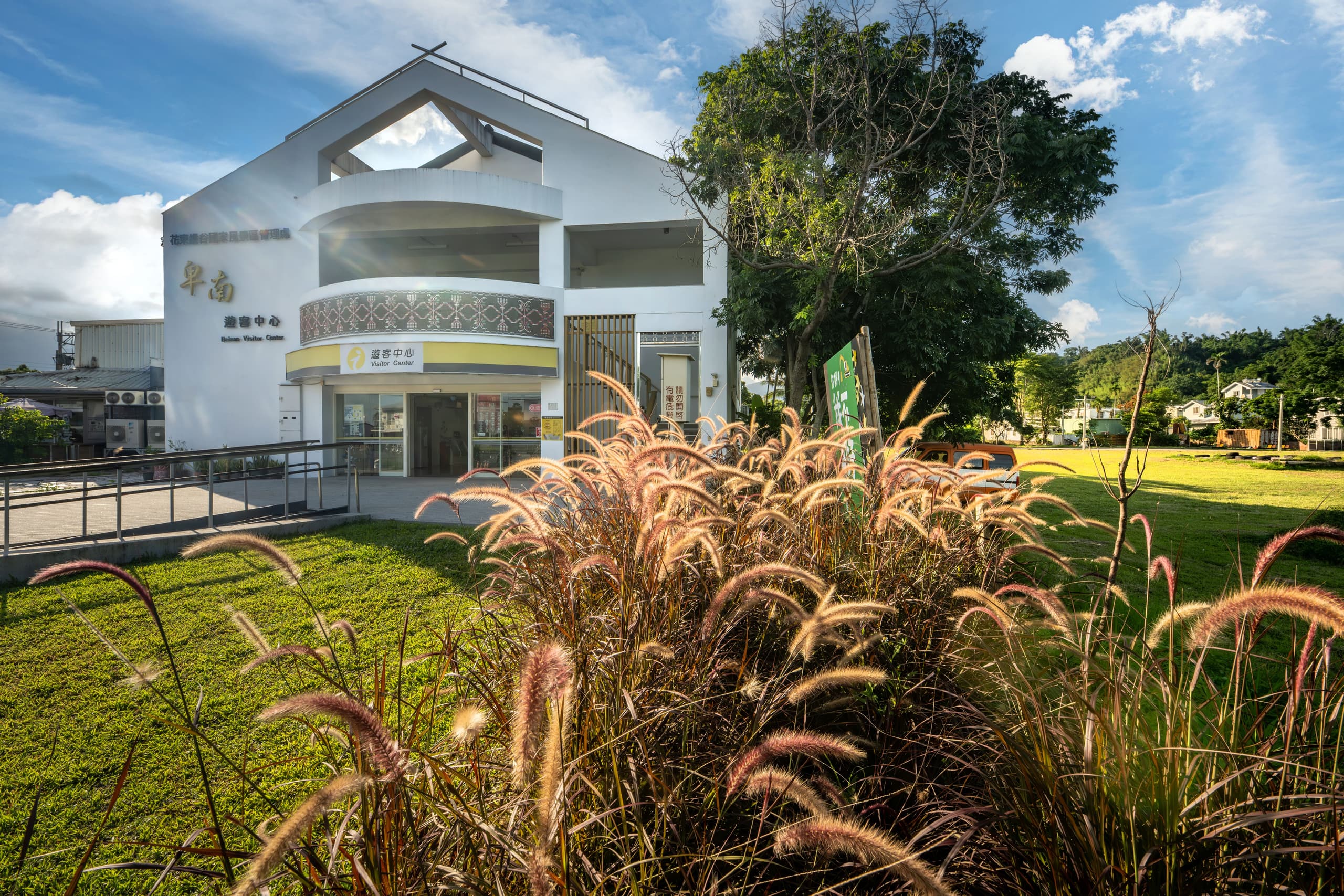
- The visitor centre: the briefing hall offers a thorough introduction to the geology of the east coast
「The finest view is the one worth waking early for.
」
Pair It with Fish at Chenggong Harbour
Ten minutes south of Sanxiantai is Chenggong Fishing Harbour (成功漁港) — Taitung's largest fishing port, and the east coast's biggest hub for billfish.
- September to March: billfish season (black marlin, striped marlin), sold fresh off the boat at Xingang Fish Market (新港漁市)
- March to June: mahi-mahi season — the sweet, firm flesh found only along the east coast
- April to July: flying-fish season, the traditional fishing season of the Amis (阿美族)
"See Sanxiantai → drive ten minutes to Chenggong Harbour for lunch" is the east-coast routine every Taitung local knows by heart. At the seafood restaurants beside Xingang Fish Market, the fish was landed that morning — fresher than at any sushi counter in Taipei.
How to Plan Sanxiantai
Half a Day (Most Recommended)
| Time | Itinerary |
|---|---|
| 04:30 | Arrive at the Sanxiantai car park, watch the sky change |
| 05:00 | Sunrise (summer timing) |
| 05:30 | Walk the mainland-side coast and the white lighthouse, viewing the arches and islets from the shore (bridge closed for renovation; loop trail across on the islets reopens once the bridge does) |
| 07:30 | Drive ten minutes to Chenggong Harbour |
| 08:30 | Breakfast by the harbour (fish just off the boat) |
| 10:00 | Continue north on Highway 11: Baxiandong, Changbin |
A Full Day (Along the East Coast)
Add: the coastal art at Jialulan (加路蘭) → the Xindong Sugar Factory in Dulan (都蘭新東糖廠) → Shanyuan Bay (杉原灣) → Taitung City
How to Get to Sanxiantai
- By car: north from Taitung City along Highway 11, about 1 hour 10 minutes (55 km)
- By private car: recommended. There are no buses at sunrise hour, so a hired car is by far the easiest way
- By bus: the Taiwan Tourist Shuttle East Coast Line (frequent by day, none before dawn)
Which Season Suits Best
- April to June: the sea at its bluest, mahi-mahi season, few crowds
- July to August: the earliest sunrises (before 05:00), the summer sea at its grandest
- September to November: billfish season begins, autumn light turns gentle
- December to February: strong northeast monsoon, fierce swells — but the colours of sunrise are especially beautiful
A Last Word
What Sanxiantai teaches is this — world-class scenery is often very close to us; we simply don't wake early enough.
It's only an hour's drive from Taitung City, yet far fewer people see the sunrise than come to take photos.
And that is Taitung's gift to the earnest traveller: rise just one hour earlier, and you'll see a postcard no one else has seen.
A postcard the three immortals set aside for us, long, long ago.
Further reading:
- An afternoon in the artists' town of Dulan: One Sugar Factory, a Circle of Artists, a Stretch of Sea
- String the valley's slowness together with this coast: Luminous · Slow Valley × Coast, 3 Days (staying throughout at the Luminous Hot Spring Resort)
- For the full east coast: East Coast Tribes, 3 Days
Next —
Want to turn this place into a trip?
Leave the car, the stay, the food, and the guide to us — a team that actually lives in Taitung. Message us on LINE with where and when, and we'll make it real.
A rough plan & quote the same day · no charge unless you're happy · no hard sell
See the related trip →Image credits
- Hero: 花東縱谷國家風景區管理處 · media.taiwan.net.tw · 政府資料開放授權條款 第 1 版
- Secondary: 花東縱谷國家風景區管理處 · media.taiwan.net.tw · 政府資料開放授權條款 第 1 版
Sources
More stories —
Other local stories
Beinan Site · Prehistoric Culture · A 5,000-Year Story
5,000 Years Ago, People Were Already Lighting Fires, Eating, and Burying Their Dead in Taitung
The Beinan Site, beside Kangle Station in Taitung City, is the largest prehistoric settlement ever found in Taiwan and the largest slate-coffin burial ground anywhere in the Pacific Rim and Southeast Asia. The Beinan Culture, which flourished here from roughly 5,000 to 2,300 years ago, left behind a complete record of dwellings, graves, jade, and pottery. Discovered in 1980 during construction of the South-Link Railway, it was excavated under archaeologists Sung Wen-hsun and Lien Chao-mei, yielding about 1,600 burials, over 99% of them slate coffins. The crescent stone pillars (3,500 years old) are the most striking remains still standing on the surface. For travellers who want to understand that Taitung was not first settled a mere hundred years ago.
2026-05-31 · 6 min read
Brown Avenue · The Version Without the Photo Line · A Story from Chishang
A Tree Named "Tea Offering," Lent for a Decade to a Movie Star
Brown Avenue runs 2.2 kilometres along Jinxin Road No. 3 in Chishang Township, Taitung, deliberately kept clear of power poles and houses. After Takeshi Kaneshiro drank tea beneath its bishopwood tree for an airline commercial in 2013, the road became famous overnight — but since 2023, the official name of the "Takeshi Kaneshiro Tree" has reverted to its original "Tea Offering Tree." As people who live in Taitung, we offer you the truest story of this road — including the tree's real name, how Chishang locals actually ride it, and which season is right.
2026-05-31 · 5 min read